What if you could make money for each word that people text to eachother on their smart-phones? I think it's possible to monetize the auto-correct spelling feature of these phones. There is a chance that this is already being done however, because of its concealed and very subtle nature.
As a lawyer, I spent precious few of my daily text messages talking about the bar. When I did text the word 'bar', it was often because I wanted to stop studying and have a barbeque. So, I would hit up my friends with a text. I would take out my HTC Hero Droid phone and type in, "Barbeque and Nazi Zombies?". But, on the HTC Hero, as soon as one types in "Barb", the phone gives "Barn" and "BARBRI" as suggestions for the word you are trying to type. Thus reminding me that I had to wake up early the following morning for 4 hours of video-taped classes.
For those of you who don't know BARBRI, it is the name of one of the popular bar study courses - it is a trademark. It is unlikely that BARBRI is aware of Droid's generous execution of its auto-correct software. If BARBRI was aware, it would probably be alright with this use. In fact, BARBRI and other trademark owners would probably pay for Droid's auto-correct to suggest that trademarks are what the phone user "intends" to type into a text.
Imagine if Facebook could expose you to it's brand every time you type "face" into your phone. With my Droid, if you type "face" followed by the letter 'b', 'n', or 'v', one of the suggestions for what you intend to type is indeed "Facebook". Thus, Facebook "owns" the real estate of two letters of the alphabet that aren' even in its name. I'm not sure if Facebook knows of this generous execution of Droid's auto-correct code.
This auto-correct code could be created in such a way as to suggest trademarks based on the trademark owner who paid the most. Every time you type "dont", your phone tells you that you must be typing "Sony", and Droid gets a nickel because you were exposed to the trademark. Well, right now Doird probably doesn't get anything, but it could...
Try typing the word "stood" into a Droid phone. Does the phone ask if you are trying to type its name - "Droid"? My phone does. If you write the code that tells people what they mean to type, then it's easy to play favoritism with yourself.
The code could be written so that if I type Pepsi, it suggests Coca-Cola. At least it could be written that way if Coke were Droid's customer. Otherwise, it should suggest Tab.
Friday, December 17, 2010


Thursday, December 9, 2010
Boardwalk Empire - Public Domain At Its Best
So many of us are drawn into alternate realities, often, by television, the
ubiquitous media that permeates the human race. But basic cable hardly offers
what we crave. Enter Home Box Office (HBO).
HBO was responsible for the Sopranos, the show about a New Jersey gangster
and his family, which ended three years ago. It is also responsible for the new
gangster show, Boardwalk Empire. HBO also broadcasts Entourage, the show based
on Mark Wahlberg’s experiences as an up-and-comer. HBO can also claim Oz, Sex
in the City, and Six Feet Under as its own productions.
After watching episodes of each of these shows, it becomes apparent where
the producers can save money without the audience really noticing. Because if
there is one thing you want to avoid as a producer (at least if you are
postured like HBO), it’s the appearance of frugality. Viewers do not want to
watch a show and say, “Wow, they must have done this for very little
money,” because if they did, firms like HBO would hardly be able to
justify their premium on top of cable. In fact, many viewers attain
satisfaction from a show, such as Boardwalk Empire, when they watch the show
and think that everything in it came with a large price tag
All of these shows have the commonality that, if they are successful,
advertising can be sold, product promotions may become common place, and there
is also the holy grail of syndication. These are all ways to save and make money,
but they do not appear (at least no pervasively) until the show has enjoyed
some success. Also, advertising, clothing promotions, and syndication are
usually noticeable, even by the less than discerning viewer. Even Joe Schmoe
knows when he’s seen enough advertisements, when every character drinks a
Coca-Cola with the label showing, or when he is watching a rerun.
So, how does HBO save money while still convincing the average viewer that
no expense is being spared? By taking advantage of the public domain. The
public domain consists of works that are not protected by copyright or related
rights, and it is free for anyone to use.
For example: in one of the birthday episodes of Entourage, the guys all sing
the song: Happy Birthday. This is an expensive undertaking because Happy
Birthday is under copyright and is owned by AOL Time Warner. The ownership
interest is worth about $2 million per year. Elsewhere
in the same episode, the guys can be seen watching an old black-and-white
movie. The movie is likely in the public domain, meaning that the expensive
license acquired for the right to sing Happy Birthday was offset by the free
license for use of the movie.
In Boardwalk Empire, use of the public domain is more apparent, especially
in its wonderful soundtrack. Boardwalk’s music consists of several songs that
are likely from the public domain: “So Long, Oo Long (How Long You Gonna
Be Gone)”, performed by Seabreeze Park Wurlitzer Band Organ, was written
by Al Bernard in 1920; “Battle Hymn of the Republic”, performed by
Vince Giordano and the Nighthawks, was written by Julia Ward Howe in 1861;
“Tenting On the Old Camp Ground”, performed by Seabreeze Park
Wurlitzer Band Organ, was written by Walter Kittredge in 1863; “Some of These
Days”, performed by Sophie Tucker, was written by Shelton Brooks in 1910; “String
Quartet No. 5 in F Minor” was written by Joseph Haydn in 1772; “By the Waters
of Minnetonka”, performed by Zen Confrey, was published by Thurlow Lieurance in
1913, but he borrowed the melody from an older Indian song; “Good Morning,
Judge” was recorded by Sophie Tucker sometime between 1920 and 1922; “Don’t
Take Away Those Blues” was originally performed by Flo Bert between 1920 and
1928; “An Old Fashioned Garden”, was first performed in the early 1900s by
Olive Kline; “I Never Knew I Had A Wonderful Wife”, performed by Vince Giordano
and the Nighthawks Feat. Stephen De Rosa, was written by Lew Brown and Albert
von Tilzer in 1919; “Fascination”, performed by Craig Duncan, was written by
F.D. Marchetti in 1905 and published in 1932.
Songs published prior to 1923 are presumptively in the public domain,
meaning that you or I could use the same song and make a profit from it. The
songs published well before 1978 are in the public domain if their copyright
protection has lapsed. That doesn’t mean that you can download the songs as
performed by the artists on Boardwalk Empire. But you could use the sheet music
as you wish, which is what the producers of Boardwalk did. The producers of
Boardwalk paid good musicians to perform the public domain songs for use in the
television show. Thus, the producers were able to remove the cost of having to
pay for a license to use the underlying sheet music by taking advantage of the
public domain.
Additionally, any of the publicity rights associated with the characters
represented on Boardwalk are likely free to exploit, as many of the characters
depicted, such as Al Capone, died decades ago. The story for Boardwalk Empire
was lifted from a factual history of New Jersey written by Nelson Johnson,
which was experiencing slow sales at the time, and was likely lifted at a
relatively small cost for that reason. Facts are very similar to works in the
public domain because neither are protected by copyright – copyright protects
not facts or ideas, but the expression thereof. Thus, I submit that the show,
which seems lavish, and really is, is also not as expensive a production as one
would think at first view. Like many shows, it takes advantage of the public
domain. Like few shows, it does it with seamless elegance.
ubiquitous media that permeates the human race. But basic cable hardly offers
what we crave. Enter Home Box Office (HBO).
HBO was responsible for the Sopranos, the show about a New Jersey gangster
and his family, which ended three years ago. It is also responsible for the new
gangster show, Boardwalk Empire. HBO also broadcasts Entourage, the show based
on Mark Wahlberg’s experiences as an up-and-comer. HBO can also claim Oz, Sex
in the City, and Six Feet Under as its own productions.
After watching episodes of each of these shows, it becomes apparent where
the producers can save money without the audience really noticing. Because if
there is one thing you want to avoid as a producer (at least if you are
postured like HBO), it’s the appearance of frugality. Viewers do not want to
watch a show and say, “Wow, they must have done this for very little
money,” because if they did, firms like HBO would hardly be able to
justify their premium on top of cable. In fact, many viewers attain
satisfaction from a show, such as Boardwalk Empire, when they watch the show
and think that everything in it came with a large price tag
All of these shows have the commonality that, if they are successful,
advertising can be sold, product promotions may become common place, and there
is also the holy grail of syndication. These are all ways to save and make money,
but they do not appear (at least no pervasively) until the show has enjoyed
some success. Also, advertising, clothing promotions, and syndication are
usually noticeable, even by the less than discerning viewer. Even Joe Schmoe
knows when he’s seen enough advertisements, when every character drinks a
Coca-Cola with the label showing, or when he is watching a rerun.
So, how does HBO save money while still convincing the average viewer that
no expense is being spared? By taking advantage of the public domain. The
public domain consists of works that are not protected by copyright or related
rights, and it is free for anyone to use.
For example: in one of the birthday episodes of Entourage, the guys all sing
the song: Happy Birthday. This is an expensive undertaking because Happy
Birthday is under copyright and is owned by AOL Time Warner. The ownership
interest is worth about $2 million per year. Elsewhere
in the same episode, the guys can be seen watching an old black-and-white
movie. The movie is likely in the public domain, meaning that the expensive
license acquired for the right to sing Happy Birthday was offset by the free
license for use of the movie.
In Boardwalk Empire, use of the public domain is more apparent, especially
in its wonderful soundtrack. Boardwalk’s music consists of several songs that
are likely from the public domain: “So Long, Oo Long (How Long You Gonna
Be Gone)”, performed by Seabreeze Park Wurlitzer Band Organ, was written
by Al Bernard in 1920; “Battle Hymn of the Republic”, performed by
Vince Giordano and the Nighthawks, was written by Julia Ward Howe in 1861;
“Tenting On the Old Camp Ground”, performed by Seabreeze Park
Wurlitzer Band Organ, was written by Walter Kittredge in 1863; “Some of These
Days”, performed by Sophie Tucker, was written by Shelton Brooks in 1910; “String
Quartet No. 5 in F Minor” was written by Joseph Haydn in 1772; “By the Waters
of Minnetonka”, performed by Zen Confrey, was published by Thurlow Lieurance in
1913, but he borrowed the melody from an older Indian song; “Good Morning,
Judge” was recorded by Sophie Tucker sometime between 1920 and 1922; “Don’t
Take Away Those Blues” was originally performed by Flo Bert between 1920 and
1928; “An Old Fashioned Garden”, was first performed in the early 1900s by
Olive Kline; “I Never Knew I Had A Wonderful Wife”, performed by Vince Giordano
and the Nighthawks Feat. Stephen De Rosa, was written by Lew Brown and Albert
von Tilzer in 1919; “Fascination”, performed by Craig Duncan, was written by
F.D. Marchetti in 1905 and published in 1932.
Songs published prior to 1923 are presumptively in the public domain,
meaning that you or I could use the same song and make a profit from it. The
songs published well before 1978 are in the public domain if their copyright
protection has lapsed. That doesn’t mean that you can download the songs as
performed by the artists on Boardwalk Empire. But you could use the sheet music
as you wish, which is what the producers of Boardwalk did. The producers of
Boardwalk paid good musicians to perform the public domain songs for use in the
television show. Thus, the producers were able to remove the cost of having to
pay for a license to use the underlying sheet music by taking advantage of the
public domain.
Additionally, any of the publicity rights associated with the characters
represented on Boardwalk are likely free to exploit, as many of the characters
depicted, such as Al Capone, died decades ago. The story for Boardwalk Empire
was lifted from a factual history of New Jersey written by Nelson Johnson,
which was experiencing slow sales at the time, and was likely lifted at a
relatively small cost for that reason. Facts are very similar to works in the
public domain because neither are protected by copyright – copyright protects
not facts or ideas, but the expression thereof. Thus, I submit that the show,
which seems lavish, and really is, is also not as expensive a production as one
would think at first view. Like many shows, it takes advantage of the public
domain. Like few shows, it does it with seamless elegance.
Monday, November 22, 2010
Misunderstanding Intellectual Property
Every Saturday morning, I go to The Bagelry at UNH and meet with other NH lawyers. Two Saturdays ago, I was made aware of an effort by a hotel owner to trademark "Mount Washington" (apparently, I should read the Bar News more often). Of course I asked for elaboration, and I learned that a Florida based company, CNL Financial Group, was trying to get a federal trademark registration after buying the hundred-year-old Mount Washington Hotel. Further, CNL is now trying to get other local businesses to stop using the words "Mount Washington" in a way that truthfully advertises their goods or services.
NH, as a state, likely owns the identifier "Mount Washington" in the same way that Idaho potatoes are from a defined region in Idaho, Champagne (real Champagne) only comes from a defined region in France, real Feta comes only from Greece, etc. The premise of this argument is that when a region of the world is responsible for the quality of the goods or services, that region, and not an individual entity, owns the trademark. Thus, if you own a store in the Mount Washington area, you should be able to affix the name "Mount Washington" to the store's signs as a truthful indicator of source. However, if NH doesn't even try to claim ownership, it is unlikely to be awarded the rights to "Mount Washington".
People also seem to continually conflate the terms patent and trademark. From an Associated Press news post: "Larry Magor, managing director of the hotel [that is claiming exclusive rights to "Mount Washington"], said the company is trying to protect the resort's identity, not patent the name." Of course the company is not trying to patent the name - patents are for inventions and they haven't invented anything. Perhaps having such management is the reason that CNL hasn't asserted its trademark rights already.
 The local newspapers covering this issue are not asking the right questions. Fosters said in an article on November 16, 2010 that: "Florida-based CNL Lifestyle Properties said Tuesday it has revised its application for the trademark to say it's just for lodging services, such as a hotel or inn." This quote is misleading because CNL has applied for not one but six trademarks at the US Patent and Trademark Office - none of these has been amended recently. The first application (Serial Number 76690738), which has never been amended, is to be used for retail services, not lodge services. The second application (76690740) is for restaurant services - it was amended two years ago. The third application (76690735) is for entertainment services - it was amended two years ago. The next two applications (76690739 and 76690736) seem to be for the hotel services. The last application (76690733) is for health spa services, and it was last amended two years ago. It seems that Fosters didn't dig enough.
Another local station, WMUR, reported on the topic: "'We're not about trying to put a fence around the name 'Mount Washington' as it could relate to other businesses," said Stephen Rice, senior vice president of CNL. "Those properties have nothing to fear.'" Given the sever applications listed above, it appears that CNL is trying to build a fence around the name "Mount Washington" but the confusing nature of intellectual property allows him to say the opposite, and few people have the wherewithal to dissent.
Most people believe that one cannot have a trademark unless one registers it. This is not true. As soon as you use a mark, like "Mount Washington", you can ask later users of the mark to stop if the later use is likely to be confused with your use. So, considering CNL is claiming in its trademark applications that the mark was first used in 1902, why have they been silent on owning the mark until filing a federal application? Answer: people ascribe too much value to federal applications and registrations and are unwilling to rely on their common law rights. Seems to me that laches may apply in such a way as to bar CNL's assertion of ownership of "Mount Washington".
This case may be analogous to the Concord Coach, where the world's finest horse-drawn coaches were allowed exclusive rights to call themselves by the name Concord. The argument is that the Mount Washington Hotel offers services which are superior to other hotels in the area, and those "other hotels" should not get a free ride on the Mount Washington Hotel's expenditure of time and money in making its name. The only way for the Mount Washington Hotel to stop others from free-riding is to assert ownership in the mark.
NH, as a state, likely owns the identifier "Mount Washington" in the same way that Idaho potatoes are from a defined region in Idaho, Champagne (real Champagne) only comes from a defined region in France, real Feta comes only from Greece, etc. The premise of this argument is that when a region of the world is responsible for the quality of the goods or services, that region, and not an individual entity, owns the trademark. Thus, if you own a store in the Mount Washington area, you should be able to affix the name "Mount Washington" to the store's signs as a truthful indicator of source. However, if NH doesn't even try to claim ownership, it is unlikely to be awarded the rights to "Mount Washington".
People also seem to continually conflate the terms patent and trademark. From an Associated Press news post: "Larry Magor, managing director of the hotel [that is claiming exclusive rights to "Mount Washington"], said the company is trying to protect the resort's identity, not patent the name." Of course the company is not trying to patent the name - patents are for inventions and they haven't invented anything. Perhaps having such management is the reason that CNL hasn't asserted its trademark rights already.
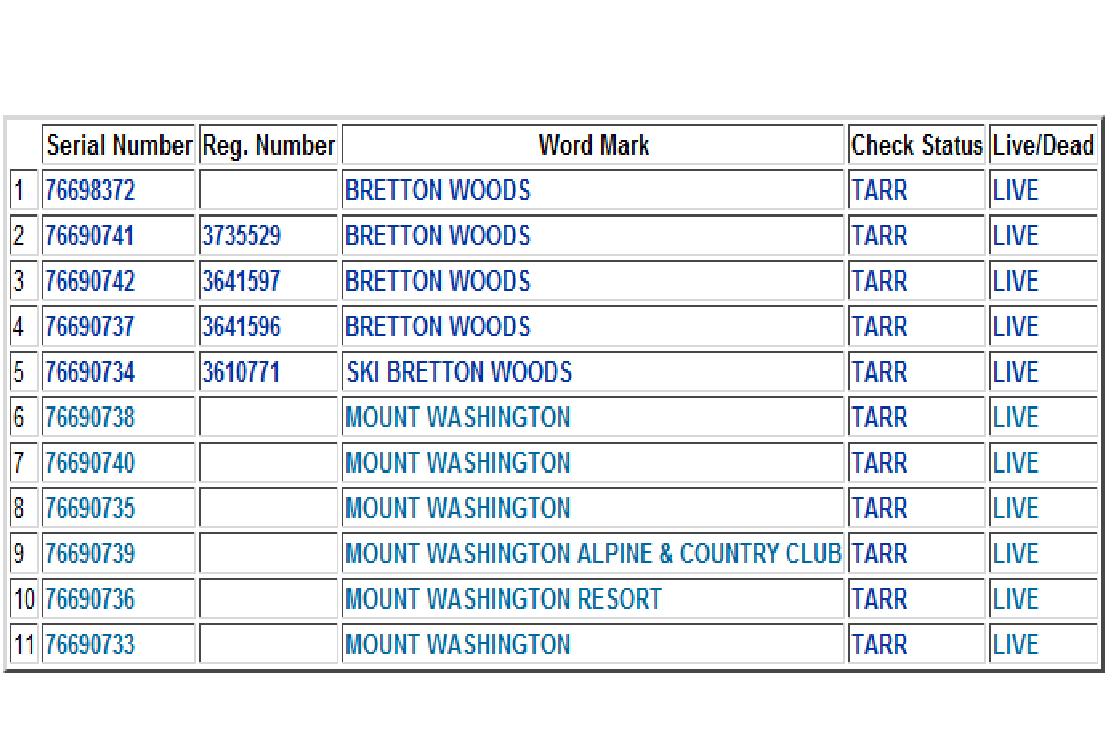
Another local station, WMUR, reported on the topic: "'We're not about trying to put a fence around the name 'Mount Washington' as it could relate to other businesses," said Stephen Rice, senior vice president of CNL. "Those properties have nothing to fear.'" Given the sever applications listed above, it appears that CNL is trying to build a fence around the name "Mount Washington" but the confusing nature of intellectual property allows him to say the opposite, and few people have the wherewithal to dissent.
Most people believe that one cannot have a trademark unless one registers it. This is not true. As soon as you use a mark, like "Mount Washington", you can ask later users of the mark to stop if the later use is likely to be confused with your use. So, considering CNL is claiming in its trademark applications that the mark was first used in 1902, why have they been silent on owning the mark until filing a federal application? Answer: people ascribe too much value to federal applications and registrations and are unwilling to rely on their common law rights. Seems to me that laches may apply in such a way as to bar CNL's assertion of ownership of "Mount Washington".
This case may be analogous to the Concord Coach, where the world's finest horse-drawn coaches were allowed exclusive rights to call themselves by the name Concord. The argument is that the Mount Washington Hotel offers services which are superior to other hotels in the area, and those "other hotels" should not get a free ride on the Mount Washington Hotel's expenditure of time and money in making its name. The only way for the Mount Washington Hotel to stop others from free-riding is to assert ownership in the mark.
Monday, November 15, 2010
16-bit, Silver Screen, or Lyrics... A Race to Register.
Who owns the phrase: "It's on like Donkey Kong"? Is it the maker of the video game which takes its namesake directly from the quoted phrase? Is it the giant gorilla that dominated the pre-video game era? Or is it the rapper that popularized the phrase in its entirety?
Donkey Kong was originally a game where the player would control Mario, bringing the Italian plumber up a series of ladders and ramps. The player would also have to jump and hammer the barrels thrown by Donkey Kong, an evil Princess kidnapping gorilla. Since its inception, the game has evolved into several spin-offs. Nintendo released Donkey Kong in 1981.
The chain of title of King Kong's intellectual property is well described in Universal City Studios, Inc. v. Nintendo Co., Ltd., 746 F. 2d 112, (2nd Cir. 1984): "Universal, a giant in the entertainment industry, maintains that it owns the trademark in the name, character and story of "King Kong." The King Kong character and story, of course, need no introduction. Universal traces its ownership of the trademark from RKO General's (RKO) efforts to exploit the goodwill created by its 1933 film classic of the same name. It asserts that RKO's commercial use of the name and character of King Kong created the trademark; that the rights to the trademark were passed from RKO to Richard Cooper, son and heir of King Kong creator Merian Cooper, pursuant to a judgment resulting from a claim brought by Richard Cooper against RKO alleging that RKO had exceeded the license originally granted by Merian Cooper to make the original King Kong motion picture; and that Richard Cooper subsequently transferred to Universal for consideration the rights he obtained from RKO."
The phrase, "It's on like Donkey Kong" was used by Ice Cube on his acclaimed 'The Predator' album. The first tercet of his song, 'Now I Gotta Wet'cha' reads, "It's on like Donkey Kong. You wanted that fast buck, now I gotta light that ass up." The album came out in 1992.
 On November 9, 2010, Nintendo filed a trademark application for "It's on like Donkey Kong". One can find the application in a search at USPTO.GOV. The application is filed under Section 1B of the Lanham Act (Trademark Act), which means that it is not based on use of the phrase in selling anything. However, trademark law allows one to register a trademark with a mere intent to use that mark, as opposed to actually using the mark to sell video games in interstate commerce (Section 1A). Thus, Nintendo, although it claims the phrase has been used to describe its games, isn't willing to swear on it.
On November 21, Nintendo will be releasing Donkey Kong Country Returns and actually using the phrase in commerce in its likely pervasive ad campaign. After that date, Nintendo is likely to amend its trademark application to amend use, effectively converting the 1B (non-use based) application to a 1A (use based) application. The importance of the distinction between 1B and 1A filing bases is that only that latter will have any real commercial viability. An application wherein use is never alleged (the trademark is never used in commerce) can only remain an application for a total of three years. But, twelve days is all Nintendo needed to be first in line for federal protection of the phrase, "It's on like Donkey Kong". This protection would preclude Universal Studios and Ice Cube from making any video games using the same famous phrase.
Donkey Kong was originally a game where the player would control Mario, bringing the Italian plumber up a series of ladders and ramps. The player would also have to jump and hammer the barrels thrown by Donkey Kong, an evil Princess kidnapping gorilla. Since its inception, the game has evolved into several spin-offs. Nintendo released Donkey Kong in 1981.
The chain of title of King Kong's intellectual property is well described in Universal City Studios, Inc. v. Nintendo Co., Ltd., 746 F. 2d 112, (2nd Cir. 1984): "Universal, a giant in the entertainment industry, maintains that it owns the trademark in the name, character and story of "King Kong." The King Kong character and story, of course, need no introduction. Universal traces its ownership of the trademark from RKO General's (RKO) efforts to exploit the goodwill created by its 1933 film classic of the same name. It asserts that RKO's commercial use of the name and character of King Kong created the trademark; that the rights to the trademark were passed from RKO to Richard Cooper, son and heir of King Kong creator Merian Cooper, pursuant to a judgment resulting from a claim brought by Richard Cooper against RKO alleging that RKO had exceeded the license originally granted by Merian Cooper to make the original King Kong motion picture; and that Richard Cooper subsequently transferred to Universal for consideration the rights he obtained from RKO."
The phrase, "It's on like Donkey Kong" was used by Ice Cube on his acclaimed 'The Predator' album. The first tercet of his song, 'Now I Gotta Wet'cha' reads, "It's on like Donkey Kong. You wanted that fast buck, now I gotta light that ass up." The album came out in 1992.

On November 21, Nintendo will be releasing Donkey Kong Country Returns and actually using the phrase in commerce in its likely pervasive ad campaign. After that date, Nintendo is likely to amend its trademark application to amend use, effectively converting the 1B (non-use based) application to a 1A (use based) application. The importance of the distinction between 1B and 1A filing bases is that only that latter will have any real commercial viability. An application wherein use is never alleged (the trademark is never used in commerce) can only remain an application for a total of three years. But, twelve days is all Nintendo needed to be first in line for federal protection of the phrase, "It's on like Donkey Kong". This protection would preclude Universal Studios and Ice Cube from making any video games using the same famous phrase.
Thursday, October 28, 2010
They’re Coming to Get You, Barbara. You Didn’t Reserve Your Rights.
In 1968, George Romero finished his film “Night of the Living Dead.” While first theatrical distribution of the movie was taking place, the title of the movie was changed from “Night of the Flesh Eaters” to “Night of the Living Dead” soon before theatrical release. In the process of changing the title of the film, the Walter Reade Organization (in charge of the theatrical distribution) neglected to add the notorious (c).
Thus, the film was released theatrically in 1968 without a claim to copyright. Under the applicable law of the time, the owner of a copyright lost all rights to a work if he did not affirmatively claim copyright in the work’s initial publication, so the movie immediately lapsed into the public domain. Since this time, the movie has been one of the most downloaded feature length movies extant in the public domain.
This draconian law of forfeiture led the motion picture and music industries to lobby Congress for greater copyright protection during contemplation of the Copyright Act of 1976 and, eventually, accession of the United States into the Berne Convention in 1989. The result of this extensive lobbying effort caused a great change in the paradigm of copyright. Where every work was presumptively unprotected before (because a work would lapse into the public domain absent an affirmative claim to copyright), after the accession to the Berne Convention by the US, works were presumptively protected.
Indeed, the Berne Convention obligates countries to abandon requirements of formalities in gaining copyright protection for their works. Having no formalities means that copyright protection attaches to a particular work as soon as a work is created. No formalities also means that no paperwork needs to be filled out to maintain copyright protection. In the current state of the law, a copyright holder need not claim copyright or maintain copyright, he only needs to create. Upon creation of a protectable work, copyright attaches and remains for the life of the author plus 70 years.
In order to be in compliance with the Berne Convention, the US was required to remove all formalities form its copyright law. As the word “formalities” includes those applicable to securing copyright and to maintaining copyright, the norms of copyright registration and copyright renewal after a specified term were removed. Thus, as soon as a creative work is created, it is protected irrespective of whether it is registered; renewal is now automatic. The end result of these new laws is that any and all creative works are protected for 70 years after the death of the author.
One of the major flaws of these new laws is that permission is now presumed to be required to use a work, as copyright attaches at the creation of a work, not to any formal requirement. Also, the public domain will not grow significantly until 2018. However, in celebration of the public domain and some of its pioneers, like Eric Eldred, I am screening Night of the Living Dead at my school this Friday.
Thus, the film was released theatrically in 1968 without a claim to copyright. Under the applicable law of the time, the owner of a copyright lost all rights to a work if he did not affirmatively claim copyright in the work’s initial publication, so the movie immediately lapsed into the public domain. Since this time, the movie has been one of the most downloaded feature length movies extant in the public domain.
This draconian law of forfeiture led the motion picture and music industries to lobby Congress for greater copyright protection during contemplation of the Copyright Act of 1976 and, eventually, accession of the United States into the Berne Convention in 1989. The result of this extensive lobbying effort caused a great change in the paradigm of copyright. Where every work was presumptively unprotected before (because a work would lapse into the public domain absent an affirmative claim to copyright), after the accession to the Berne Convention by the US, works were presumptively protected.
Indeed, the Berne Convention obligates countries to abandon requirements of formalities in gaining copyright protection for their works. Having no formalities means that copyright protection attaches to a particular work as soon as a work is created. No formalities also means that no paperwork needs to be filled out to maintain copyright protection. In the current state of the law, a copyright holder need not claim copyright or maintain copyright, he only needs to create. Upon creation of a protectable work, copyright attaches and remains for the life of the author plus 70 years.
In order to be in compliance with the Berne Convention, the US was required to remove all formalities form its copyright law. As the word “formalities” includes those applicable to securing copyright and to maintaining copyright, the norms of copyright registration and copyright renewal after a specified term were removed. Thus, as soon as a creative work is created, it is protected irrespective of whether it is registered; renewal is now automatic. The end result of these new laws is that any and all creative works are protected for 70 years after the death of the author.
One of the major flaws of these new laws is that permission is now presumed to be required to use a work, as copyright attaches at the creation of a work, not to any formal requirement. Also, the public domain will not grow significantly until 2018. However, in celebration of the public domain and some of its pioneers, like Eric Eldred, I am screening Night of the Living Dead at my school this Friday.
Monday, October 25, 2010
A Taste of Their Own Medicine...
I don’t know if I am the only person to have seen an analogy between Amanda Knox’s trial in Italy and the Sacco and Vanzetti trial in New York in the 1920s. It seems like Italy paid us back for what we did to their nationals so many years ago. Not that I think Amanda Knox is innocent, but I think there were problems with her trial. Apparently though, this is not the only recent event to set the world’s Karmic realignment straight.
We have all noticed, and hopefully not been subject to, the Recording Industry Association of America’s (RIAA) unscrupulous pursuit of filesharers and other infringers. The Recording Industry has, almost without equivocation, gone after non-commercial downloaders for the maximum awards of damages available under the Copyright Act. This pursuit has been one-way only, at least in America; which brings me to my analogy.
The Canadian Recording Industry has recently been sued for infringement (irony) in a class action. Specifically, the defendants in this case are the four main members of the Canadian Recording Industry: Sony BMG Canada, Warner Music Canada, EMI Canada, and Universal Music Canada.
The infringement stems from the Canadian Recording Industry’s practices on its compilation releases. When the above named record labels decide to release a compilation CD (think of “NOW That’s What I Call Music”, only the Canadian version), there are many songs they include in the release but don’t clear the rights to. Thus, when many songs are put onto these compilations, the labels simply place them on a “pending” list – as in “the right to use these songs has not been granted, but hopefully will be in the future.”
According to the Toronto Star, the plaintiffs are asking for $60 billion. That should teach the Recording Industry of Canada an equal but opposite lesson to the lesson the RIAA has “taught” to people like Joel Tennenbaum, Jammie Thomas, and the like. I will keep an eye on this one for any interested readers…
We have all noticed, and hopefully not been subject to, the Recording Industry Association of America’s (RIAA) unscrupulous pursuit of filesharers and other infringers. The Recording Industry has, almost without equivocation, gone after non-commercial downloaders for the maximum awards of damages available under the Copyright Act. This pursuit has been one-way only, at least in America; which brings me to my analogy.
The Canadian Recording Industry has recently been sued for infringement (irony) in a class action. Specifically, the defendants in this case are the four main members of the Canadian Recording Industry: Sony BMG Canada, Warner Music Canada, EMI Canada, and Universal Music Canada.
The infringement stems from the Canadian Recording Industry’s practices on its compilation releases. When the above named record labels decide to release a compilation CD (think of “NOW That’s What I Call Music”, only the Canadian version), there are many songs they include in the release but don’t clear the rights to. Thus, when many songs are put onto these compilations, the labels simply place them on a “pending” list – as in “the right to use these songs has not been granted, but hopefully will be in the future.”
According to the Toronto Star, the plaintiffs are asking for $60 billion. That should teach the Recording Industry of Canada an equal but opposite lesson to the lesson the RIAA has “taught” to people like Joel Tennenbaum, Jammie Thomas, and the like. I will keep an eye on this one for any interested readers…
Sunday, June 20, 2010
In the Immortal Words of Gary Gilmore and NIKE, “[Just] Do It.”
“Just do it.” This is one of the world’s most famous trademarks, and any reader will know that products bearing the phrase are NIKE products. However, not many people know where this phrase comes from.
The phrase, “Just do it,” was thought up by the advertising agency, Wieden and Kennedy. Wieden and Kennedy is an independent ad agency, started in 1982. It is located in Portland, Oregon, and is famous for its work for NIKE. Dan Wieden, one of the founders of Wieden and Kennedy, credits an interesting source for the creation of the phrase, “Just do it.”
On a not so unrelated note, a man was executed in Utah last Friday morning. Ronnie Lee Gardner was executed by firing squad on Friday, June 18, 2010. When asked if he had any last words, he replied, “I do not. No.” Does anyone think that the last words of a condemned murderer are ripe grounds for trademark goodwill? In Ronnie Lee’s case, perhaps not. But Utah’s death row is the source of the NIKE trademarked phrase, “Just do it.”
In 1972, the Supreme Court ruled that the death penalty was unconstitutional. In 1976, the Supreme Court reinstated the death penalty in a case called Gregg v. Georgia, and Utah immediately wanted to put down one of its inmates who had very recently been convicted of armed robbery and murder. This man’s name was Gary Gilmore, and he would be the first to die under the reinstated death penalty.
Gilmore murdered a gas station employee and a hotel manager. The murders took place after car thefts, assault, and robbery. Growing up, he struggled. His mother and father told him that he was illegitimate, and that he was actually the son of Harry Houdini. His father earned a living selling advertising space in magazines, perhaps helping to secure Gilmore’s place as the source of a world famous trademark.
On January 17, 1977, Gilmore was executed by firing squad. He requested that, following his execution, his eyes be used in corneal transplants. It is rumored that Gilmore’s uncle smuggled some Jack Daniels whiskey into the prison for Gilmore to imbibe prior to execution.
After Gilmore was shot by the firing squad, his brother reported that five holes were left in the body, rather than four. Thus, the firing squad did not have the traditional “blank” loaded into one of the guns. In the memoirs of the brother, titled Shot in the Heart, “the state of Utah, apparently, had taken no chances on the morning that it put my brother to death.” When Gilmore was asked for his final words, he said, “Let’s do it.”
This phrase became famous in pop culture. Gilmore’s life (and death) became the basis for a movie, where Gilmore was played by Tommy Lee Jones. Gilmore inspired one of Jack Nicholson’s performances, in a movie called The Postman Always Rings Twice. An episode of Saturday Night Live featured a skit with a Christmas song satire called, “Let’s Kill Gary Gilmore for Christmas.” Gilmore inspired a UK top twenty hit, called “Gary Gilmore’s Eyes.” In a deleted scene of an episode of Seinfeld, Jerry says, “Well, in the immortal words of Gary Gilmore, ‘Let’s do it.’” In an episode of the television show Roseanne, Darlene is asked if she is ready to get married, and she says the same thing that Seinfeld said, quoting Gilmore.
While this list of references to Gilmore is not exhaustive, it is certainly highlighted by Wieden and Kennedy’s use of the phrase, “Let’s do it,” when crafting NIKE’s “Just do it.” Gary Gilmore, the convicted murderer and armed robber, who gave away his corneas, got drunk before getting shot, and was lucid enough immediately before being shot to use a very catchy phrase, would live on in the goodwill of NIKE.
When an article about Gilmore’s death caught the eye of Dan Wieden, he changed the contours of the phrase slightly, and it became, “Just do it.” Thus, a condemned man, who was drunk, who donated his eyes, and was in a rush to just do it (i.e., be shot by five bullets), inspired Dan Wieden to create NIKE’s famous trademarked phrase. One of the most popular phrases in the world has a dark pedigree that seems to have faded over time. The “goodwill” attached to the phrase is likely worth billions.
The phrase, “Just do it,” was thought up by the advertising agency, Wieden and Kennedy. Wieden and Kennedy is an independent ad agency, started in 1982. It is located in Portland, Oregon, and is famous for its work for NIKE. Dan Wieden, one of the founders of Wieden and Kennedy, credits an interesting source for the creation of the phrase, “Just do it.”
On a not so unrelated note, a man was executed in Utah last Friday morning. Ronnie Lee Gardner was executed by firing squad on Friday, June 18, 2010. When asked if he had any last words, he replied, “I do not. No.” Does anyone think that the last words of a condemned murderer are ripe grounds for trademark goodwill? In Ronnie Lee’s case, perhaps not. But Utah’s death row is the source of the NIKE trademarked phrase, “Just do it.”
In 1972, the Supreme Court ruled that the death penalty was unconstitutional. In 1976, the Supreme Court reinstated the death penalty in a case called Gregg v. Georgia, and Utah immediately wanted to put down one of its inmates who had very recently been convicted of armed robbery and murder. This man’s name was Gary Gilmore, and he would be the first to die under the reinstated death penalty.
Gilmore murdered a gas station employee and a hotel manager. The murders took place after car thefts, assault, and robbery. Growing up, he struggled. His mother and father told him that he was illegitimate, and that he was actually the son of Harry Houdini. His father earned a living selling advertising space in magazines, perhaps helping to secure Gilmore’s place as the source of a world famous trademark.
On January 17, 1977, Gilmore was executed by firing squad. He requested that, following his execution, his eyes be used in corneal transplants. It is rumored that Gilmore’s uncle smuggled some Jack Daniels whiskey into the prison for Gilmore to imbibe prior to execution.
After Gilmore was shot by the firing squad, his brother reported that five holes were left in the body, rather than four. Thus, the firing squad did not have the traditional “blank” loaded into one of the guns. In the memoirs of the brother, titled Shot in the Heart, “the state of Utah, apparently, had taken no chances on the morning that it put my brother to death.” When Gilmore was asked for his final words, he said, “Let’s do it.”
This phrase became famous in pop culture. Gilmore’s life (and death) became the basis for a movie, where Gilmore was played by Tommy Lee Jones. Gilmore inspired one of Jack Nicholson’s performances, in a movie called The Postman Always Rings Twice. An episode of Saturday Night Live featured a skit with a Christmas song satire called, “Let’s Kill Gary Gilmore for Christmas.” Gilmore inspired a UK top twenty hit, called “Gary Gilmore’s Eyes.” In a deleted scene of an episode of Seinfeld, Jerry says, “Well, in the immortal words of Gary Gilmore, ‘Let’s do it.’” In an episode of the television show Roseanne, Darlene is asked if she is ready to get married, and she says the same thing that Seinfeld said, quoting Gilmore.
While this list of references to Gilmore is not exhaustive, it is certainly highlighted by Wieden and Kennedy’s use of the phrase, “Let’s do it,” when crafting NIKE’s “Just do it.” Gary Gilmore, the convicted murderer and armed robber, who gave away his corneas, got drunk before getting shot, and was lucid enough immediately before being shot to use a very catchy phrase, would live on in the goodwill of NIKE.
When an article about Gilmore’s death caught the eye of Dan Wieden, he changed the contours of the phrase slightly, and it became, “Just do it.” Thus, a condemned man, who was drunk, who donated his eyes, and was in a rush to just do it (i.e., be shot by five bullets), inspired Dan Wieden to create NIKE’s famous trademarked phrase. One of the most popular phrases in the world has a dark pedigree that seems to have faded over time. The “goodwill” attached to the phrase is likely worth billions.
Subscribe to:
Posts (Atom)